Mass Effect Trilogy
Every one of us wants to be the hero of our time.

Mass Effect Trilogy is a sequence of three Mass Effect games that form an epic, almost mythical, rise of a human hero in the face of a galactic annihilation. I can safely say there has not been a game that touched me this deeply since my innocent childhood. At the end of the trilogy, I was ravaged by the sense of resolution it offered. I was obsessed for days, thinking about what had happened during my experience and about my companions. Despite the fact that I am now writing about the game, please note that it is impossible for me to convey in mere words the full extent of the beauty I experienced. Consider playing! (buy)
I will first give an overview of the game plot. Then I will be more technical and attempt to explain why the game succeeds. Then I will conclude with a general impression of the game. I will avoid focusing on minor details about game mechanics (which in my opinion are just means to an end), but clutch to the big picture. There are spoilers, but they are essential to illustrating why the game is so mighty.
Plot overview: what it means to become a hero
(This plot is based on the game decisions made by me. There are many other possible plots depending on how the decisions are made.)
The year is late 2100s. The human race has been empowered with faster-than-light travel and discovered that they are only one of many advanced species in the galaxy, a newbie. In this time, you play as Commander Shepard, whose appearance, gender, and background can be customized to your liking.
In Mass Effect 1, you begin as a regular soldier investigating some sinister activities of a Spectre (analogous to a Jedi in Star Wars) in the galactic council. Then you make a fatal discovery: the galaxy is trapped in an endless cycle of extinction. Every 50,000 years, an ancient machine race, called the Reapers, invade the galaxy and wipe out all advanced organic civilization. They leave behind only the scattered ruins of technology, destroying all evidence of their own existence [from Official Plot Summary]. This Spectre is a pawn of the Reapers. Through your investigation, you build your crew, face a Reaper personally, and become the first human Spectre in history. In a stunningly orchestrated climax, you destroy the Spectre and save the galaxy from the seemingly invincible Reaper, becoming a hero known throughout the universe.
In Mass Effect 2, you begin by dying in an unknown attack, thrown into the void. Cerberus, a human association ruthless in advancing human interest at the expense of other galactic species, decides to bring back Shepard from death for his/her symbolic value through the use of advanced medical technology and unlimited resources. Through this "Lazarus" Project, you are resurrected, and work for the head of Cerberus (called the Illusive Man) to organize a team to stop the Reapers' another threat and prepare for their impending invasion.
In Mass Effect 3, the period of the current cycle is over, and the Reapers descend on the galaxy like crows on corpses. Despite Shepard's previous warnings, the galactic community is ill-prepared to face such an invasion, and many homeworlds (including Earth) are decimated. Shepard manages to form an alliance between major species by breaking down their old grudges. Together, they work on a weapon called the Crucible whose design was passed down from the previously annihilated races as the only tool to destroy the Reapers. Shepard goes back to Earth to put a final showdown against the Reapers. Unfortunately, the alliance is still unable to stop the Reapers. Many of your dear companions die and all hope seems lost. At that moment, you risk your life to make a breakthrough and finish the Crucible. But then you learn inside the Crucible that in fact you must either destory most of the galaxy along with the Reapers, or sacrifice yourself to become a synthetic program that controls the Reapers. You choose the latter, and the galaxy is freed from the Reapers and has a future at last. The name Shepard becomes a legend.
Aspects about Mass Effect that make it soar
Enormous scale

Each game takes around 30 hours to complete, with a moderate dose of self-initiated exploration (some take as long as 80 hours). The total number of hours for the trilogy adds up to almost 100 hours.
There are certain types of emotion that arise only from a long journey. Were you touched at the end of the seventh installment of Harry Potter or the third Lord of the Rings movie? During the 100 hours of play in Mass Effect, you surf the galaxy in your personal ship Normandy, meet countless characters and get to know them (across the three games). This is enough time to evoke the feeling of being glad to see an old friend.
As a specific example, you recruit an alien character in Mass Effect 1. He is somewhat irksome and rebellious, but you eventually grow to like and even respect him for his other qualities. By the end of the first game, you feel like he is a genuinely great pal. Now, in Mass Effect 2, he is nowhere to be seen, off to take care of his own business. Only 20-30 hours of additional play into the game will you encounter him again. The gladness of seeing each other's face is mutual.
Nearing the end of trilogy, you will have spent so many hours, having experienced even emotions that only come attached to the waning of age. This galactic community that you have grown so attached to is counting on you to stop the invaders. The sense of duty, honor, and resolution that you feel about saving the galaxy is a result of the sheer scale of the game.
Open-ended relationship with companions

In Mass Effect, you can have romance with your crew members. The developer Bioware is famous for a dialogue system that allows you to communicate with the game characters, however limited. At any point of play, you can choose to hang out in your ship, visiting your crew members in their own cabins. In this private space, you can have conversations that touch on intensely personal issues of your members (which can initiate side missions).
Let me provide a specific example. One of the galactic species is called the Asari. They have bright blue skin, and are one of the most advanced civilizations in the universe. In Mass Effect 1, you recruite an Asari named Liara T'Soni. When I first saw her, I had no particular feelings, mildly repulsed by her exotic appearance.
But as I progressed through the game and got to know her better, I learned to appreciate the strange mixture of qualities in her. Fiercely intelligent in mind but pure in heart, beautiful and terrible at the same time, remarkably capable yet humble. In the real world, it is probably very hard to find someone in which these qualities coexist.
Eventually, I developed genuine liking of her. Strangely, I have rarely if not never felt the feeling of having a crush on someone in real life. The sensation of happiness and the beating of the heart upon just thinking about the character came to me as both bizarre and pleasant. I really think it is a cool outcome. Think about it; a virtual character has taught me what it (kind of) feels like to be in love.
At the end of Mass Effect 3, in the final stance against the Reapers, Liara is killed in a combat. But the situation is too urgent to mourn for her. When my time has come to sacrifice myself to save the galaxy, at the moment I initiate a procedure to turn myself into an immortal but dead program, the memory of Liara flashes on the screen (presumably, the game stores which characters you have romance with and show them at this point). There is no way I can describe how I felt at that moment, on seeing Liara's face one last time.
Tight restraints for maximal impact
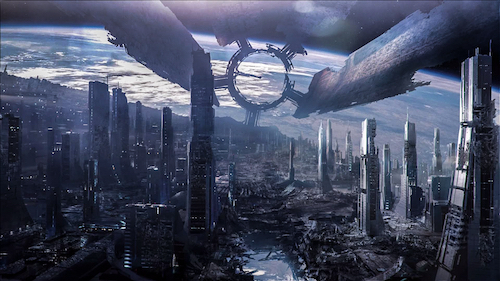
For most of the game play, special sound and visual effects are very reserved. There are cutscenes and background music, but these are mostly for a storytelling purpose. It is clear that the developers concentrated on improving the game experience itself without relying on easy "cheats" of flashy visuals and grandiose music.
To me, Mass Effect put the Japanese anime and games in stark contrast. J. products tend to be too enthusiastic to impose appropriate restraints that are crucial to achieve truly powerful experiences. Wild moves will be displayed too often, dramatic music will be played too frequently, etc.
On the other hand, Mass Effect is strictly regularized. It focuses on the core experience at all times (not the immediate entertainment specific to that given moment). Consequently, the story alone is immensely enjoyable. When you add additional components on top of this already powerful base, its emotional impact shines forth blindingly.
For instance, in Mass Effect 3, there is a certain signature piano piece --- a deep, poignant, sorrowful yet resolute score. This piece is only played at the most critical moments. (In my play, I think I encountered this piece only twice, one in the beginning and one in the ending.) In the ending, when my Shepard chose to give up her life and grabbed those controllers to begin disintegrating her body, this music began trickling down the screen, touching the very bottom of my inner being. This kind of narrative power only comes from careful reservation. As C. S. Lewis said,
Mass Effect certainly listened to this wisdom.
Conclusion
Playing Mass Effect Trilogy has taught me
- How good it feels to rise to become the hero of our time
- What it is like to sacrifice myself to save the world
- What it is like to have a crush on someone
